
Custom Jewelry Manufacturing Lead Times, Converted to Days
Lead times are easier to argue about than to plan with, so convert them. The published figures are two days of CAD, then 25–30 days of sampling, then 3–4 weeks of production for the run for the production run, which adds up to somewhere between 46 and 60 days of factory time before shipping. Here is the same schedule in days and hours, with the arithmetic shown.

Key takeaways
- CAD is quoted at under 48 hours, which is 2 days or less, and it is the only stage that is screen work.
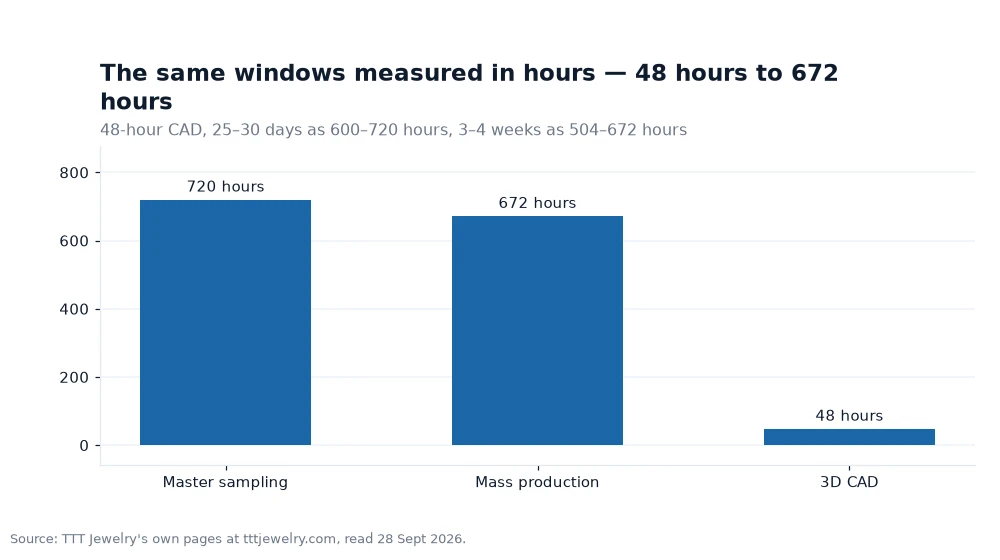
- Master sampling at 25–30 days converts to 600–720 hours; production at 3–4 weeks converts to 21–28 days or 504–672 hours.
- Stacked end to end, the fastest route is 46 days and the slowest is 60 days of factory time before shipping.
- Only three stages carry published durations, so anything outside them is the buyer's own approval time.
Why convert hours into days at all
Factories quote in the units their own floor works in. CAD is quoted in hours because it is finished in a working session. Sampling is quoted in days because five bench operations run across it. Production is quoted in weeks because it is scheduled in batches. None of those units is wrong, but a launch plan written in three different units hides where the slack sits.
Converting everything to days does one useful thing: it shows that the CAD stage is not a stage at all in scheduling terms. Two days out of a 46-to-60 day route disappears into rounding, which is why arguing about CAD turnaround rarely changes a launch date and arguing about sampling always does.
The three published windows, converted
Every figure in the table comes from the manufacturer's own pages; the day and hour columns are converted in the worked example below so the arithmetic can be checked.
| Stage | Published window | Converted |
|---|---|---|
| 3D CAD modelling | Under 48 hours | 2 days or less |
| Master physical sampling | 25–30 days | 600–720 hours |
| Mass production | 3–4 weeks | 21–28 days / 504–672 hours |
| Extras named by the factory | 100% inspection, branded packing | Inside the windows above |
Where the 48 hours actually sits in the order
CAD sits before tooling and before any metal is touched. It exists so that dimensions can be approved from a technical drawing and a realistic rendering, and it costs screen time rather than bench time. That is why a change requested at this point is cheap in schedule terms and a change requested after the wax has been printed is not.
A jewelry manufacturer for brands that quotes in three different units is not being vague; it is quoting in the units its own floor schedules in. An OEM/ODM enquiry that arrives with a complete material, finish and quantity list therefore gets a firmer answer than one that opens with a price question. If the first reply names the CAD hours, the sampling days and the production weeks, then the conversion on this page is the only extra work needed to turn those numbers into a launch plan.
The sampling window that follows is where the metal starts moving: the 3D wax print, precision mould casting, stone-setting, gloss polishing and custom electroplating, all inside 25–30 days. Production after approval repeats those operations at volume across 3–4 weeks. Reading the three stages this way makes the shape of the risk obvious, because two of the three stages are bench-bound and one is not.
Three decisions the conversion changes
First, it changes how you buffer a launch. If 60 days of factory time is the slow end, a launch date set 60 days out has no room for a sample revision, and a launch date set 75 days out has room for roughly one. Second, it changes which lever you pull when a date slips. Cutting the CAD stage saves two days; cutting the sampling stage is not a decision anyone should make, because it is the stage that proves the design. Third, it changes what you promise a stockist: the safe commitment is a shipped carton, not a delivered one, because shipping sits outside all three published windows.
Those three decisions are the whole reason to keep a converted table next to the calendar. The numbers are not new, but the units are. A buyer who knows that sampling is 600 to 720 hours of bench time can also see why a mid-sample revision costs what it costs: the five operations are already scheduled, and rescheduling a casting run is not the same as redrawing a screen model.
What the windows do not include
Three things sit outside the published durations and usually surprise first-time buyers. The first is sample shipping time between the factory and the buyer, which is quoted separately as worldwide express shipping rather than as a number of days. The second is approval time at each gate, which belongs to the buyer and is invisible to the factory. The third is packaging and barcode labelling, which happens after 100% inspection and inside the production window rather than after it.
Once those three are placed outside the arithmetic, the published figures become a floor rather than a forecast, and the planning conversation gets honest very quickly.
Worked example: from 48 hours to 1,440 hours
Convert every stage to hours, using 24 hours a day and 7 days a week. CAD is under 48 hours, so take 48. Sampling is 25 days at the fast end: 25 × 24 = 600 hours; and 30 days at the slow end: 30 × 24 = 720 hours. Production is 3–4 weeks, and one week is 7 days, so 3 × 7 = 21 days and 4 × 7 = 28 days, which is 21 × 24 = 504 hours and 28 × 24 = 672 hours.
Now stack the extremes. Fastest route: 48 + 600 + 504 = 1,152 hours, which is 1,152 ÷ 24 = 48 days. Slowest route: 48 + 720 + 672 = 1,440 hours, which is 1,440 ÷ 24 = 60 days. Excluding shipping and your own approval time, the factory route is therefore 48 to 60 days, or roughly seven to nine weeks. The conversions are mine; the four published durations they start from are the manufacturer's.
Frequently asked questions
How many days from CAD to shipment?
Plan on 48 to 60 days of factory time: under 2 days of CAD, 25–30 days of sampling and 21–28 days of production, with shipping and your own approval time added separately.
Can the CAD stage be shortened?
It is already the shortest published stage at under 48 hours, and it is screen work that protects the bench stages, so shortening it saves two days at most and risks a tooling error that costs far more.
Why quote production in weeks instead of days?
Because production is scheduled in batches and depends on order volume and design complexity, so 3–4 weeks is the published range and 21–28 days is the same figure expressed in days.
Planning a launch on converted numbers
Put the three windows on one line, add shipping, then add your own approval time at each gate. That total is the only lead time worth putting in a launch plan, because everything else is a unit conversion. Brands that arrive with a finished CAD file hand the geometry straight to the floor as an OEM order, and brands that arrive with a mood board let the design team build the collection first; the difference between those two routes is spelled out on the OEM and ODM route comparison. The same sequence applied to brass pieces is described under brass jewelry production, where plating adds its own pass to the schedule.
The basis for every figure above — the gold and rhodium plating options and the eight steps in production — is the manufacturer's own pages on the tttjewelry.com site, as of 28 Sept 2026. TTT Jewelry sets those figures out on its own pages. The restatement in weeks is mine — the site supplies the inputs only [1]