
A brand that buys ODM work is not buying a document, it is buying a managed process, and the fee, the ownership position and the quality checkpoints all come out of the same scope document. Founders who read the ODM fee as payment for a design file tend to discover the difference at the first change request, when it becomes clear that neither the design nor the process was scoped in a way that answers the question. The three topics are usually discussed separately, which is precisely why they cause disputes: cost, ownership and quality are decided by the same set of clauses, and reading them together is the only way to know what has actually been bought.
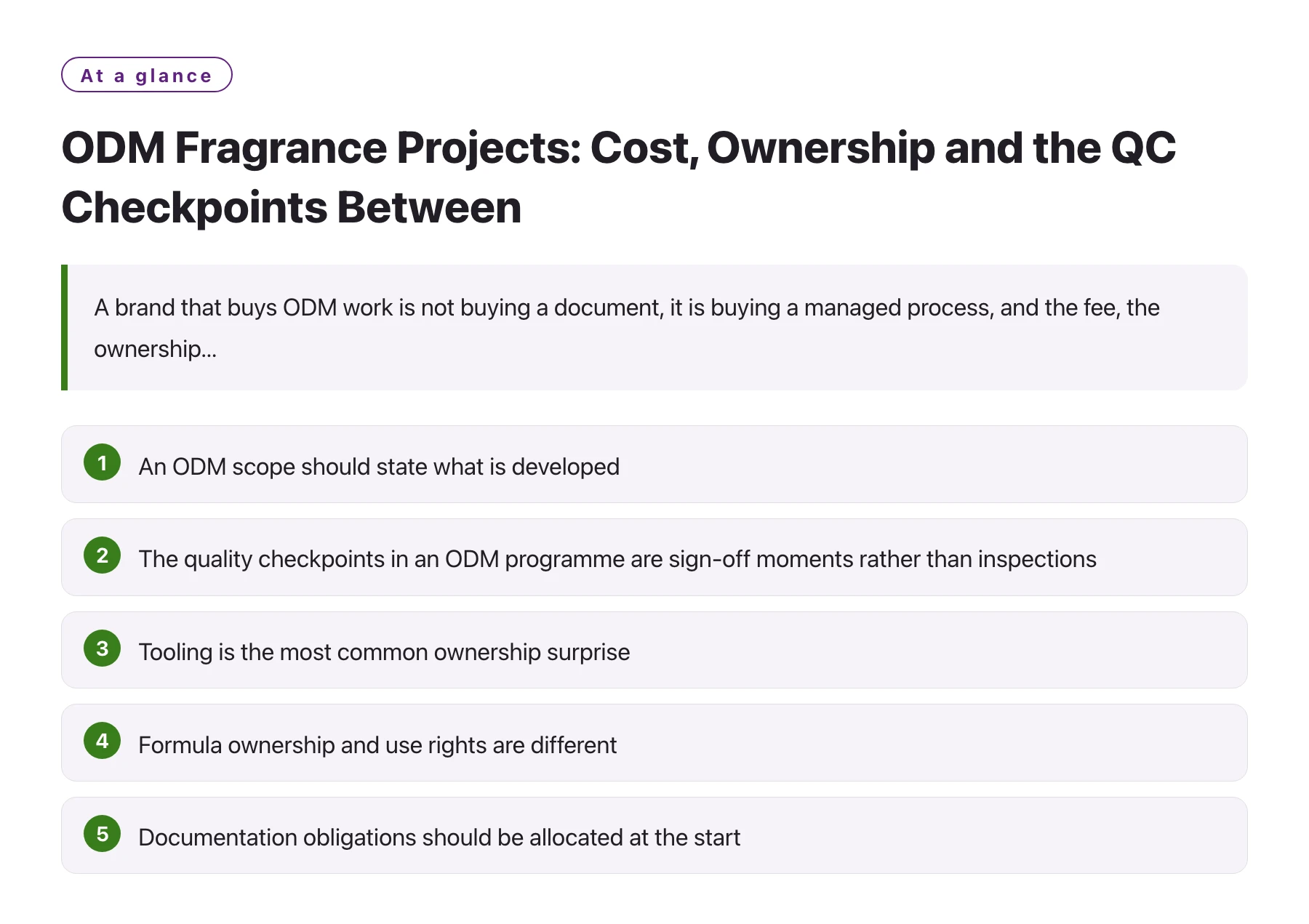
Key takeawaysAn ODM scope should state what is developed, who chooses, who owns the result and who bears the cost of a change, because each of those is a separate line. · The quality checkpoints in an ODM programme are sign-off moments rather than inspections, and each one should have a named party on both sides. · Tooling is the most common ownership surprise, since a brand can pay for a mould without holding any right over it. · Formula ownership and use rights are different, and the arrangement is not implied by paying a development fee [1]. · Documentation obligations should be allocated at the start, because the brand, not the factory, usually carries the responsibility for what the packaging asserts [2]. · Independent verification is a normal way to confirm what the programme produced, and it is easier to plan before production than to argue about afterwards [3].
ODM means the supplier develops the product and the brand puts its name on it. That description hides the interesting part, which is that ODM projects vary enormously in how much of the concept, the design and the ownership the supplier takes on. Two quotations that both say ODM can differ by a large margin and still be honest, because one includes packaging design and tooling while the other starts from a chosen pack.
For a travel retail launch this matters more than usual, because the channel rewards a distinctive object and punishes a generic one. A brand that wants its own bottle shape, its own closure and its own carton is buying design and tooling work, and that work has its own cost, its own lead time and its own ownership questions.
The structure below separates the three topics deliberately, and then shows where they connect.
What an ODM scope contains, and what each element settles
| Element | What it covers | The question it settles |
|---|---|---|
| Scent concept and selection | Olfactory direction, candidate development, selection rounds | How many directions are included, who chooses, and what happens when none is accepted |
| Formula development | Refinement, stability screening, adaptation to the intended product category | Who owns the composition and what rights the brand receives over it |
| Packaging and industrial design | Bottle and pack design, component sourcing, decoration concept | Whether the design is developed for the brand or drawn from an existing catalogue |
| Tooling and decoration | Moulds, coating, frosted finishes, print and foil | Who pays for tooling, who holds it, and what happens to it if the relationship ends |
| Regulatory documentation | Safety assessment inputs, material statements, labelling data | Who produces which document and who is entitled to rely on it [2] |
| Brand assets | Names, artwork, carton design, copy | What is transferred to the brand and what remains licensed |
| Production and filling | Bulk compounding, fill, assembly, release checks | What is inspected, at which stage, and against which reference |
| Change handling | The process for altering a component, formula or finish | Who bears the cost and the calendar impact of a change after sign-off |
Read as a whole, the table is a description of a project rather than a price list. The last row is the one that decides whether the quotation stays accurate: an ODM project without a change process is a fixed price for a moving product.
The quality checkpoints in an ODM programme
- Checkpoint 1: brief sign-offBoth parties agree in writing what the product is for, where it will be sold, what it must smell like in descriptive terms and what constraints apply. This is the reference for every later disagreement about fit.
- Checkpoint 2: concept selectionThe brand selects a direction from the developed candidates and the selection is recorded. From here, the discarded directions are development history rather than options that remain available.
- Checkpoint 3: formula approvalThe formula is frozen for testing, and the brand confirms that the approved version is the one that will be produced. A formula that keeps being adjusted after this point invalidates testing work.
- Checkpoint 4: pack and tooling sign-offComponents, decoration and tooling are approved together, because a change to one usually affects the others. This is the point at which tooling cost and ownership should be unambiguous.
- Checkpoint 5: pre-production sampleA sample made with production tooling and the production pack is compared against the approved reference. This is where the difference between a development sample and a manufactured product becomes visible.
- Checkpoint 6: bulk release and retained referenceThe first bulk batch is released against defined criteria, and a sealed reference is retained with the batch record. This is the checkpoint that makes every later reorder comparable.
Where ODM budgets usually go wrong
The first mistake is treating the development fee as a purchase of ownership. Paying for development and owning the resulting composition are separate matters, and the position depends on what the agreement says and on what has been registered. WIPO's material on intellectual property and business is a reasonable starting point for understanding that rights are territorial and licence-based rather than automatic, which is why the clause matters more than the invoice [1].
Tooling without rights
A brand can pay for a mould, a decoration plate or a custom closure and still have no right to move it to another supplier. The cost is real either way, but the right to use it elsewhere is a separate clause. Founders who intend to build a range over several years should treat tooling as an asset to be addressed explicitly, including what happens if volumes change or the relationship ends.
Comparing quotes that are not comparable
ODM quotations differ mostly in what they include, which means a low figure often describes a narrower project rather than a cheaper one. The discipline is to compare the scope elements line by line and to note what is absent, then to ask for the missing items to be priced. comparing fragrance manufacturing quotes is essentially an exercise in reading inclusions rather than totals.
Assuming the factory carries the compliance duty
Manufacturers provide information; the brand usually carries the responsibility for what the product claims and how it is labelled. Agreeing at the start which party produces the safety inputs, the material statements and the labelling data avoids a late scramble in which both sides assume the other has it. This is one reason to treat the ODM scope as a shared document rather than a supplier's price list.
A partner that manages the whole sequence from concept to filled bottle is easier to hold to those checkpoints, simply because fewer handovers exist. That integrated model is what a single partner from formula to finished bottle describes, and it is worth comparing against a split supply chain on the specific question of who signs at each checkpoint.
Before signing an ODM agreement, read it once for cost, once for ownership and once for quality, and check that the three readings describe the same project. The most common defect is a scope that prices development, tooling and production clearly while leaving ownership and change handling to be sorted out later. An arrangement that answers all three questions in one document, which is what brands are looking for when they search for a scent development and manufacturing partner, is a materially lower-risk choice than one that answers only the cost.
Sources
- WIPO — World Intellectual Property Organization —— The UN agency for intellectual property; resources on industrial design and patent protection relevant to product and packaging design.
- Cosmetics Europe —— The European trade association for the cosmetics and personal care industry, publishing guidance, positions and market information.
- SGS: Cosmetics, Personal Care & Household Testing —— Testing, inspection and certification services for cosmetics and personal care, including microbiological, stability and safety testing aligned with cosmetics GMP.
Frequently asked questions
Does paying an ODM development fee give the brand ownership of the formula?
Not automatically. Ownership and use rights are contractual and, where relevant, depend on what has been registered. Many ODM arrangements leave the composition with the manufacturer while granting the brand defined rights to use it. The position should be written down rather than assumed from the fact that development was paid for.
Who owns the packaging design in an ODM project?
It depends on whether the design was developed specifically for the brand or drawn from an existing catalogue, and on what the agreement states. Ask separately about the design files, the tooling and any registered rights, because a single answer about ownership rarely covers all three.
How many quality checkpoints should an ODM project have?
Enough that every irreversible decision has a recorded approval. In practice that means the brief, the concept selection, the frozen formula, the pack and tooling, a pre-production sample made with production tooling, and the release of the first bulk batch with a retained reference.
Are ODM projects cheaper than OEM projects?
They are structured differently rather than simply cheaper. ODM usually includes development, design and sourcing that an OEM buyer provides themselves, so the quoted figure covers more work while the brand gives up some control over the concept. Comparing the two requires comparing scopes, not totals.
What happens if a component changes after the tooling is approved?
It depends on which component and how it changes. Any change to a material in contact with the product usually invalidates the relevant compatibility results, and a tooling change may also affect the decoration approvals. This is why a change process belongs in the scope: without one, the cost and the calendar impact are negotiated under pressure.